What insulation works best in the rainy climate of Oregon and Washington? The answer isn’t simple, it depends on moisture resistance, drying potential, and how your specific wall and attic assemblies are built. A homeowner in Eugene spends a weekend installing fiberglass batt insulation in their exterior walls, seals everything up, and feels good about it. Two winters later, they notice a musty smell near the baseboards and pull back a section of drywall. The batts are compressed, damp, and growing mold. In this case, the failure was driven primarily by material and assembly choices, in a climate with a high number of rainy days typical of this region, those choices matter enormously.
What works in other parts of the country doesn’t automatically translate to Portland, Bend, or the Oregon Coast. Our marine climate creates a specific combination of sustained moisture exposure, low drying potential, and mild temperatures that demands a different insulation strategy than most national buying guides acknowledge. At HomeRx Insulation And Energy Savings, a family-owned company that has been insulating Oregon and Washington homes since 2019, this is the exact problem we deal with every single day.
By the end of this post, you’ll know which materials hold up in wet Pacific Northwest conditions, what R-values your home actually needs for Climate Zone 4C, and how to avoid the vapor retarder mistakes that turn a well-meaning insulation project into a mold remediation bill. This guidance is specific to the Oregon and Washington marine climate, not a national average that doesn’t account for how moisture behaves here.
Why the Rainy Climate of Oregon and Washington is uniquely hard on insulation
The Pacific Northwest’s insulation challenge isn’t about extreme cold. Portland rarely drops to single-digit temperatures, and Eugene’s winters are relatively mild compared with interior cold climates. The real problem is chronic, low-grade moisture exposure combined with temperatures that sit in the condensation-risk range for months at a time. That combination creates conditions inside wall and attic assemblies that most homeowners never see until the damage is done.
The Moisture-load problem most homeowners don’t see
Persistent rain, high ambient humidity, and minimal drying potential during cool months create a situation where poorly chosen insulation absorbs moisture, compresses, loses R-value, and eventually feeds mold. The coast and the Willamette Valley behave differently from inland Oregon and Eastern Washington, but the moisture risk is present throughout the region. Even Bend, which gets far less annual rain than Portland, sees winter humidity levels and dew-point conditions that can challenge poorly detailed assemblies, a dynamic the regional climate office data reflects in seasonal relative humidity readings.
The issue isn’t just that insulation gets wet. It’s that it stays wet. During cool PNW winters, there’s simply not enough solar energy or temperature variation to drive moisture back out of wall cavities and attic assemblies the way it can in drier climates. Moisture that enters in November may still be there in March.
Why Mild winters create a false sense of security
Oregon and Washington homeowners often underestimate their insulation needs because winters “aren’t that cold.” That logic misses the real energy and moisture problem: sustained heating loads combined with damp assemblies that never fully dry out between rain events. A wall that performs adequately in a dry climate at R-13 will underperform at that same rating here because moisture-compromised insulation loses effective R-value over time. The material you installed and the material actually doing work inside your walls can be very different things after a few wet seasons.
What Insulation Works Best in Oregon and Washington
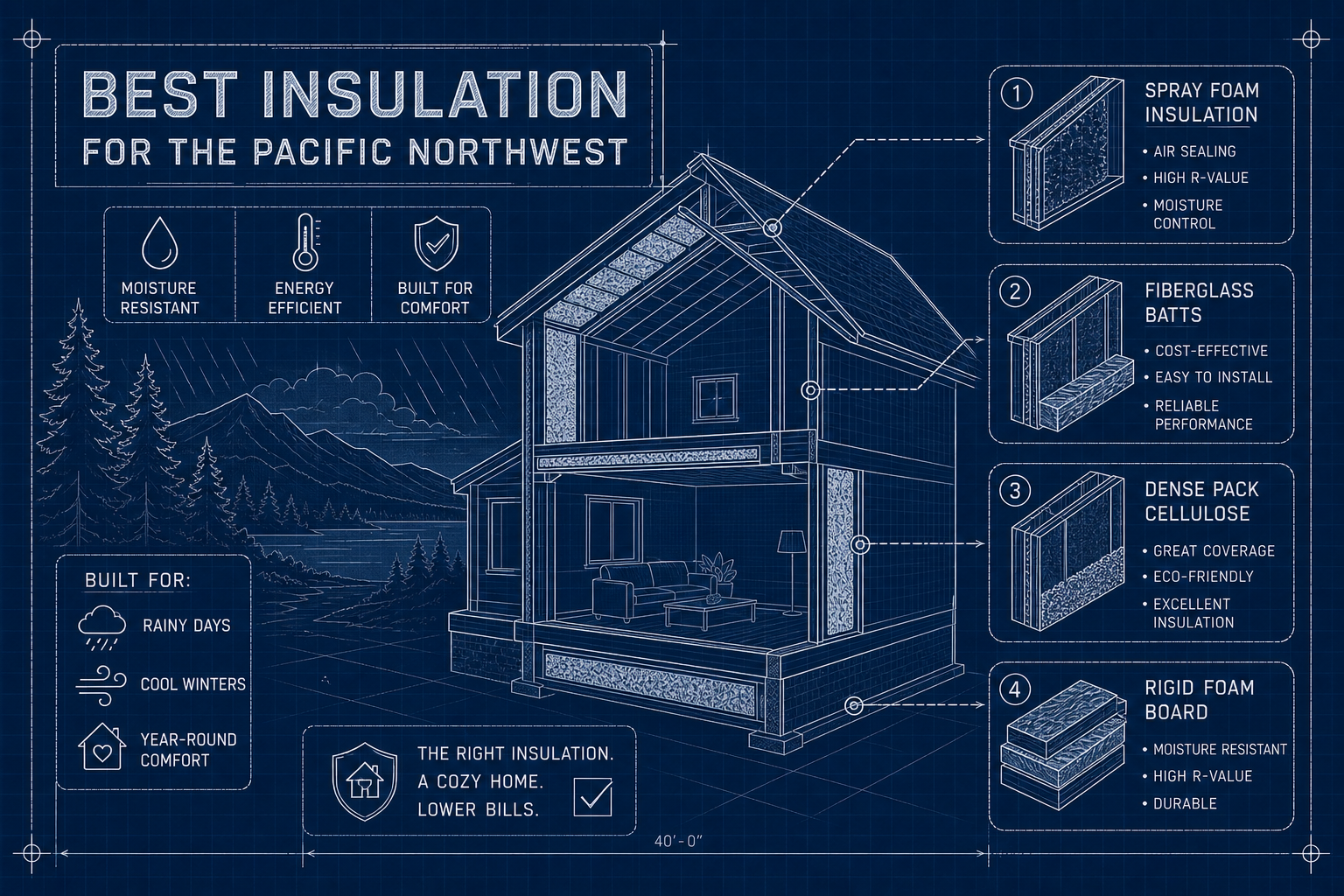
Not all insulation performs equally when the climate is this unforgiving. Here’s how the main options rank for this region, based on their ability to resist moisture, support drying, and maintain long-term performance.
Closed-cell spray foam: the strongest moisture barrier
Closed-cell spray foam is the top performer for moisture-resistant insulation in Oregon and Washington applications because it functions as both an air barrier and a vapor retarder in a single application. It resists water intrusion, eliminates many of the condensation pathways that damage other materials, and holds its R-value over time even in damp conditions. The tradeoff is worth understanding: its low vapor permeability means the assembly must be designed carefully, because closed-cell foam doesn’t allow drying if moisture ever gets trapped behind it.
The best applications for closed-cell foam in PNW homes are rim joists, crawlspace walls, and unvented roof deck assemblies where bulk moisture exposure is high and drying potential is low. In these locations, stopping moisture entry is more important than preserving a drying pathway, which is exactly what closed-cell delivers.
Mineral wool: best drying potential of the solid insulations
Mineral wool insulation is the strongest performer when drying potential matters as much as moisture resistance. It’s inorganic, which means mold has nothing to feed on. It’s also water-repellent and vapor-open, so walls insulated with mineral wool can dry in both directions if moisture ever enters the assembly. That bidirectional drying capacity is a significant advantage in a climate where assemblies stay wet for extended periods.
Mineral wool is particularly well suited for exterior continuous insulation and wall cavities in PNW assemblies designed with a rainscreen or proper weather-resistive barrier. When the exterior side is well-managed for bulk water, mineral wool gives you excellent resilience against incidental moisture without creating a vapor trap.
Choosing the best insulation for wet climates: cellulose, open-cell foam, and fiberglass
Treated cellulose can buffer moisture and resists mold if kept reasonably dry, making it a workable choice for attic insulation when paired with solid air sealing at the attic floor. Dense-pack cellulose also has genuine moisture-buffering ability, meaning it can temporarily absorb small moisture events and release them as conditions change. That’s a real advantage in certain assemblies, though it depends on good air control and bulk-water management throughout.
Open-cell foam is a weaker choice in high-moisture locations in this region because it’s far more vapor-open than closed-cell and doesn’t provide the same moisture resistance where exposure is significant. Standard fiberglass batt is the least forgiving option in damp conditions: it holds moisture, compresses under its own weight when wet, and loses effective R-value faster than any of the alternatives. From our experience opening up older Portland-area homes, fiberglass batts in exterior walls are the most common source of the damp, moldy insulation we encounter, a pattern consistent with Building Science Corporation findings on vapor-permeable materials in mixed-humid and marine climates.
R-value targets for Oregon and Washington Homes
Most of Oregon and Washington falls in Climate Zone 4C (marine). The R-value targets for this zone are higher than many homeowners realize, especially for attics, and the placement of insulation matters as much as the number on the label.
Attic and roof R-value targets for Zone 4C
Energy Star’s Zone 4C guidance calls for R-60 for uninsulated attics and R-49 where some existing insulation is already present (see the Energy Star Insulation Recommendations table for Climate Zone 4). Attic insulation consistently delivers the highest return on investment in Oregon and Washington homes because heat rises and attic bypasses are a major source of both heat loss and moisture movement. If your attic currently has 3 to 4 inches of old, settled insulation, typical of many pre-1980 Oregon homes with original fiberglass batts running at roughly R-3 to R-3.5 per inch when compressed, you’re likely sitting somewhere around R-10 to R-14, which means you’re less than a quarter of the way to the recommended target.
Placement matters here. In a standard vented attic, insulation belongs on the attic floor, not on the roof deck. If you’re converting to an unvented or conditioned attic assembly, insulating the roof deck is the right approach, but that requires a different assembly design and usually involves a combination of cavity insulation and continuous rigid foam board exterior sheathing.
Wall and crawlspace targets specific to this wet climate
For Zone 4C walls, Energy Star recommends R-20 cavity plus R-5 continuous exterior insulation (ci), with R-13 plus R-10 continuous insulation (ci) as a common retrofit path when siding is being replaced. Washington State’s energy code aligns with R-20+5 ci or R-13+10 ci for wood-frame walls (per the Washington State Energy Code, Chapter 4). The continuous exterior insulation component isn’t optional filler, it reduces thermal bridging through studs and keeps the sheathing warmer, which directly reduces condensation risk inside the wall assembly. Oregon’s residential specialty code references similar IECC-aligned targets for Climate Zone 4C.
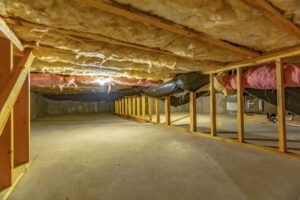
For crawlspaces, the target is R-30 for floors above vented crawlspaces and R-15 continuous insulation (or R-19 batt) for conditioned crawlspace walls. If you’re sealing and conditioning a crawlspace, closed-cell spray foam on the walls and rim joists is often the most reliable solution in this climate because it addresses both moisture and thermal performance in one application.
Vapor barriers vs. vapor retarders: where PNW homes get this wrong
This is the most common and most costly mistake we see in Pacific Northwest insulation projects. Homeowners or contractors install interior polyethylene sheeting thinking it will protect against moisture, and it ends up doing the opposite, trapping moisture inside the wall assembly and creating the mold and rot problems they were trying to prevent.
Why Poly Sheeting is the Wrong Call in Marine Climates
Intedior povy sheeting is designed for cold climates where vapor drive consistently moves from warm interior air pushing outward through the wall. In the PNW marine climate, vapor drive reverses seasonally, and the wall’s ability to dry inward is critical for managing moisture that accumulates during wet months. Placing poly on the interior side blocks that drying pathway and can trap moisture between the sheathing and the vapor barrier. The Building Science Corporation and the Oregon Residential Specialty Code both explicitly identify interior polyethylene as an inappropriate vapor control strategy for standard above-grade wall assemblies in marine climate zones.
The double vapor barrier problem is particularly damaging. When both the interior and exterior sides of a wall assembly are low-permeance, any moisture that enters from air leakage, construction processes, or incidental rain intrusion has nowhere to go. It sits in the cavity until it causes structural damage.
What actually works: smart retarders, paint, and exterior insulation strategy
For many standard PNW wall assemblies, latex paint serves as an adequate Class III vapor retarder on the interior side. Smart vapor retarders adjust their permeability with seasonal humidity, which makes them a good fit for the variable moisture conditions in Oregon and Washington. Continuous exterior insulation, especially vapor-open mineral wool, warms the sheathing, reduces condensation risk, and supports outward drying without creating a vapor trap.
The goal in any PNW wall assembly is straightforward: build a wall that can dry in at least one direction. The specific vapor control strategy depends on how much exterior insulation you have, what type it is, and what the sheathing assembly looks like. That’s exactly the kind of assembly-specific decision that benefits from a professional assessment rather than a generic recommendation.
Cost and Installation Tradeoffs for Oregon and Washington Homeowners in 2026
Knowing which materials perform best in wet climates is only useful if you can budget for the right choice. Different materials have different costs associated. Generally speaking, fiberglass costs less than mineral wool and closed-cell spray foam. Plus, access difficulty in older homes, existing insulation removal, and moisture-related prep work, like addressing existing mold or damaged sheathing before reinstalling, all add to the project cost. The cheapest material per square foot isn’t always the right answer when the local climate is this unforgiving and a failed assembly costs far more to remediate than a better material would have cost upfront.
Where Professional Installation is Non-Negotiable
Spray foam requires calibrated equipment, proper mixing ratios, and protective gear. An off-ratio spray foam application that cures incorrectly can off-gas for months and still fail to deliver its rated R-value. Crawlspace work in older PNW homes with moisture issues involves assembly decisions that interact in ways a DIY approach can get seriously wrong. Vapor retarder strategy, in particular, is one area where a well-intentioned mistake creates a mold problem that costs substantially more to fix than professional installation would have.
Attic, Walls, and Crawlspace: the Right Material for Each location
For vented attics with an accessible floor, blown-in cellulose or blown-in mineral wool paired with thorough air sealing at the attic floor is the standard recommendation. For rim joists and crawlspace walls where bulk moisture exposure is significant, closed-cell spray foam is the most reliable choice in this wet climate. Wall cavities in older homes work well with dense-pack cellulose or mineral wool paired with continuous exterior insulation when the assembly is designed to dry. Unvented roof deck assemblies call for closed-cell foam or a code-compliant combination of cavity and rigid foam board that meets the minimum exterior R-value ratio for Zone 4C.
How a Free Home Energy Assessment Removes the Guesswork
A 1960s ranch in Portland has different insulation gaps than a newer craftsman in Bend, and both of those are different from a 1940s bungalow in Eugene with original wall framing and no vapor control layer. Generic guides give you the principles; an assessment gives you the diagnosis for your specific house. At HomeRx Insulation And Energy Savings, our free home energy assessments are calibrated to Oregon and Washington conditions, not a national checklist built for an average climate that doesn’t exist here in the Pacific Northwest.
We also assist homeowners with utility rebate and tax incentive applications, including Energy Trust of Oregon programs, which can significantly offset the cost of insulation upgrades. Most homeowners are surprised by how much incentive money is available for the exact work their home needs. Getting the assessment done first means you understand what’s available before you commit to a path forward.
The Right Insulation Decision Starts with the Right Diagnosis
What insulation works best in the Pacific Northwest rainy climate comes down to three things: moisture-resistant materials, assembly designs that allow drying, and R-values matched to Zone 4C requirements. Fiberglass batts in exterior walls, interior poly vapor barriers, and under-insulated attics are the three most common failure modes we see in older Oregon and Washington homes. Each one is fixable, and each one has a clear better alternative once you understand what this climate actually demands.
In many cases, getting the vapor retarder strategy wrong leads to mold remediation costs that far exceed what was saved on the original installation. Getting the material right in the first place, even at a higher upfront cost, is the financially sound decision in a climate as unforgiving as the Pacific Northwest’s.
The next step is simple. Schedule a free home assessment with HomeRx Insulation And Energy Savings. Our experts will assess your particular home and what it needs to be comfortable and efficient in our local climate zone. Knowing which insulation works best in wet Pacific Northwest climates is the foundation. Knowing exactly what your house needs is what actually saves money long-term.